Chinese AI startup tops global embodied intelligence benchmark
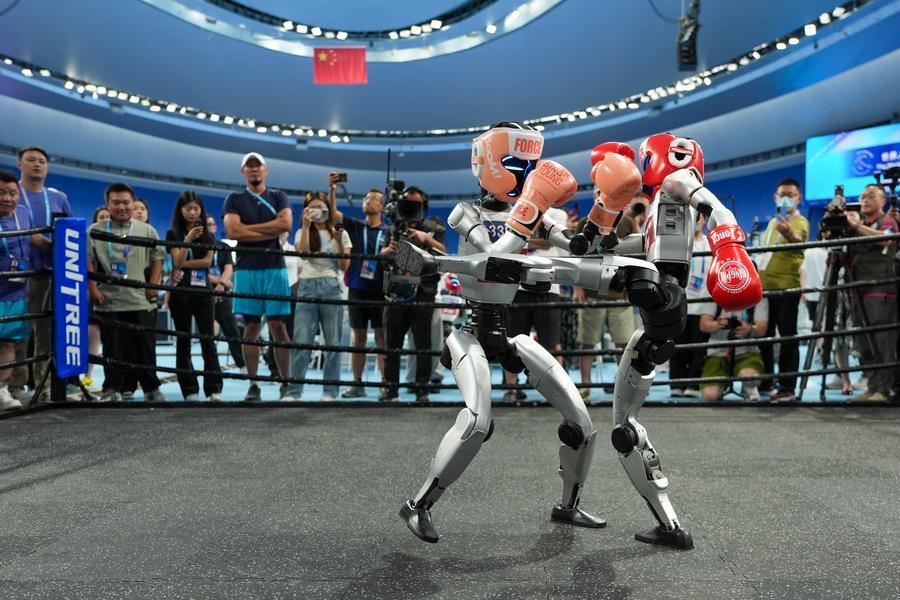
This file photo taken on 扬州新闻网最新新闿Aug. 15, 2025 shows humanoid robots combating during a kickboxing match at the 2025 World Humanoid Robot Games in Beijing, capital of China. (Xinhua/Ju Huanzong)
HANGZHOU, Jan. 13 (Xinhua) -- Chinese startup Spirit AI has said that its Spirit v1.5 embodied intelligence foundation model now ranks first according to the RoboChallenge real-world robotics benchmark, surpassing a leading U.S. model.
According to the RoboChallenge leaderboard, Spirit v1.5 has achieved a total score of 66.09 with a task success rate of 50.33 percent, outperforming the pi0.5 model developed by U.S.-based Physical Intelligence.
Spirit AI said it has open-sourced the leading model and related resources.
RoboChallenge, which industry observers often describe as a "global exam" for robots, is a real-machine evaluation platform that tests embodied intelligence models in physical environments. Its benchmarking process includes 30 tasks covering everyday operations such as object placement, target recognition and tool use.
In addition to achieving the highest overall score on the platform, Spirit v1.5 was also the only model to achieve a success rate above 50 percent, according to publicly available results.
The enterprise was founded in Hangzhou, the capital city of east China's Zhejiang Province, which is also home to AI startup DeepSeek and humanoid robotics firm Unitree Robotics. It focuses on embodied intelligence and robotics research. In June 2025, the company unveiled its Moz1 humanoid robot, targeting enterprise applications such as logistics and industrial scenarios.
Qiu Jiefan, an associate professor at Zhejiang University of Technology, said the top ranking suggests Spirit v1.5 has demonstrated strong overall capabilities across general robotics tasks and real-world execution.
"For embodied intelligence, the ability to understand and perform across multiple tasks and scenarios is very important," Qiu said, noting that while the technology is not yet ready for large-scale deployment, this latest result marks a significant step toward practical application.
Han Fengtao, founder and CEO of Spirit AI, said that Spirit v1.5 has a unified Vision-Language-Action (VLA) architecture that integrates perception, reasoning and action into an end-to-end system, reducing errors associated with established modular approaches. He said the company expects a wider range of service robots to emerge within the next two to three years.
本文地址:https://kuso.o6me3u.cc/html/99e2299878.html
版权声明
本文仅代表作者观点,不代表本站立场。
本文系作者授权发表,未经许可,不得转载。